4. What makes VE advanced, and the limits
The chapter True VE showed that the calculation is physical. This chapter shows what the VCU does beyond the basic calculation and, just as clearly, its limits.
#Features beyond the basic calculation
In the calculation, the injectors and the sensors:
| Feature | What it does |
|---|---|
| Lambda target in its own table, which the enrichments do not shift | The lambda you ask for in the target table is what the loop demands (with an ethanol sensor, added to the ethanol shift from the Flex fuel table, which is not zero by default). |
| Fuel pressure compensated in real time (with the sensor) | Fuel pump pressure drop and boost pressure enter the calculation. Below half of the rated pressure, the correction stops: the mixture leans out, but fuel is not cut. |
| Deadtime by battery voltage and by pressure, in each bank | The deadtime follows the battery voltage and the differential fuel pressure (with the sensor), which matter most on a short pulse. |
| Short pulse linearization per cylinder | Corrects the response of the large injector on a short pulse, at idle and at cruise. It starts at zero: the tuning is up to you. |
| Three banks with staging by injector opening | Splits the flow between banks without rewriting the VE. |
| Individual cylinder trim, by engine speed and by pressure | Corrects the difference between cylinders without touching the VE. |
| Flex by mixture chemistry (with an ethanol sensor) | The stoichiometric AFR follows the measured content. Details in Before you start: engine, fuel, injectors and sensors. |
| Acceleration fuel enrichment in % of the base fuel, by throttle or by pedal | The transient grows with the load, instead of being a fixed pulse. |
| Fuel flow rate, power and torque estimated in the log | Consumption and power trend with no extra instrument. Does not replace a dynamometer. |
| Valid range for the air temperature sensor and for the fuel data | An air reading outside −30 to 120 °C uses the failsafe; inside the range, even if wrong, it is used. AFR and density are held within the range of the screen. |
| Backup MAP sensor | The calculation passes to the backup, and continues with measured pressure, when the main one reports a failure, goes out of range or diverges from the backup, according to the criteria you turn on. |
In the closed loop and in the learning (details in VE closed loop and in Self-learning: VE learning (LTFT)):
| Feature | What it does |
|---|---|
| Closed loop with a model of the delay to the O2 sensor | The correction speed follows the estimated delay: calmer at idle, faster under load. The delay depends on the position of the O2 sensor, which you enter. |
| Closed loop correction limit by manifold pressure, with a total ceiling | Limits how much the loop adds or removes at each pressure (by default, from 1.0 bar up: +5% and −3%), with a 25% ceiling for correction and learning together. |
| Learning on a grid of up to 16 × 16, with confidence per cell | The first step of a cell enters in full; from 19 transfers on, each new step enters at 5%. |
| Learns only with the engine at steady state, in the same region for a few seconds | Only a correction of 1.5% or more, for 4 s in a row in the same cell, is transferred to the learning, and it stops on a transient. |
| Locks: air, fuel pressure or battery out of normal, ethanol varying, sensor in failsafe, saturated injector, cut | The learning stops while one of these conditions is active, with the factory ranges described in Self-learning: VE learning (LTFT). |
| Permanent memory, also saved at shutdown | Saves the table with the engine stopped for 2 s and the VCU still on. At power-up, it loads only a valid table. |
| Stuck O2 sensor detection | If, in 5 s, lambda varies less than 0.002 while the pulse varies more than 10%, the VCU considers the O2 sensor stuck and the correction falls to zero. |
| Diagnosis of the learned error, on the computer | Four tests point to an error that is not the VE's: injector, pressure or fuel; deadtime; air temperature; error only at idle. |
| Apply to VE with a preview | Shows beforehand the cells that change; changes only cells with confidence, with no extrapolation, and clears the learning without asking for confirmation. |
#The limits
#Atmospheric pressure: a fixed 1.013 bar
The VCU has no barometer. For the air calculation, it adds a fixed value, 1.013 bar, to the MAP that appears on the screen.
Leave the Calibration of the MAP sensor screen at 0. It is not a zero button: it adds the same value across the whole range of the sensor and changes the air calculation in every cell.
With an external MAP sensor, the same applies to the Sensor offset: do not use it to make the MAP show 0 with the engine off.
#Load is always the manifold pressure
There is no VE table by throttle, nor a blend of MAP with throttle.
Setting the Main fuel table field to TPS (throttle position), on the Engine settings screen, changes only the ignition.
The VCU reads the MAP in time, not by engine angle. On the internal sensor, it averages a few readings (Smoothing level (average points), 3 by default) and passes the result through a fixed 10 Hz filter.
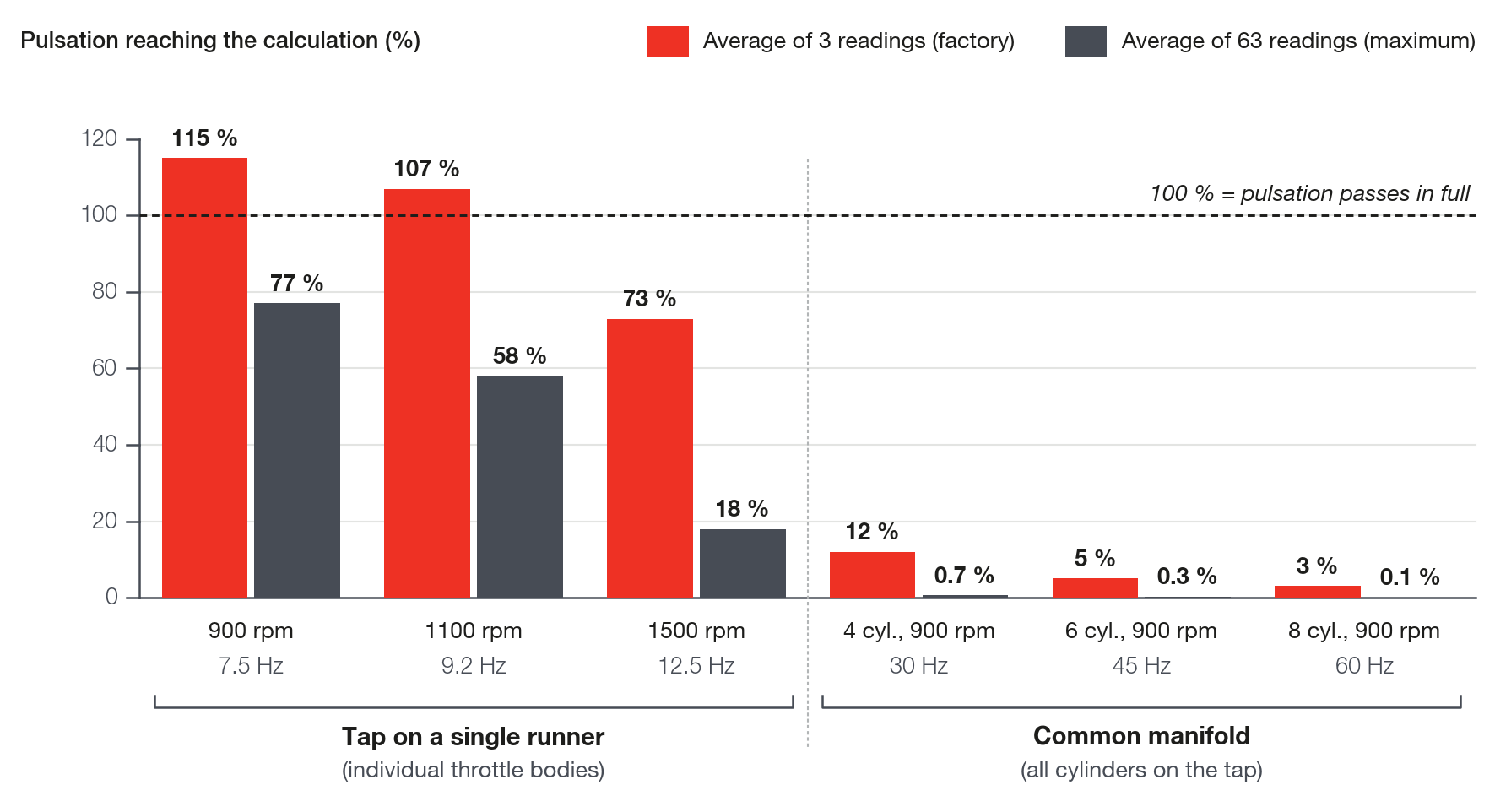
On a common manifold the pulsation is fast and the filter filters out almost all of it. On a tap connected to a single runner, the idle pulsation has a low frequency and passes in full.
#Individual throttle bodies and aggressive cam
- Aggressive cam (high overlap) with a single throttle: use the VE with the normal MAP. At 900 rpm, only 12% of the pulsation of 4 cylinders reaches the calculation, and 3% with 8 cylinders.
- Individual throttle bodies: the MAP tap must represent the average of all the runners. A common line connecting all the runners adds up the pulsations of the cylinders and, according to the calculation, moves the frequency into the range that the filter removes. With the internal sensor and Use MAP sensor on, never leave the tap open to the air (see Before you start: engine, fuel, injectors and sensors).
- With the tap on a single runner, the pulsation at 900 rpm is 7.5 Hz and arrives in full: the calculation catches one point of the wave, not the average.
- Raising the Smoothing level (average points) does not solve it: at the maximum, 63, 77% of the pulsation still arrives at 900 rpm.
- If the learning screen shows Transient with the engine stable at idle, the MAP is oscillating more than MAP change that defines a transient (0.05 bar by default) or the throttle is varying more than TPS change that defines a transient (5% by default). Fix the signal first; only then raise the limit that is triggering, which also protects against real transients.
- With individual throttle bodies, the ignition can go by throttle (Main fuel table at TPS) and the VE acceleration fuel enrichment already comes from the throttle in Acceleration fuel enrichment source selection.
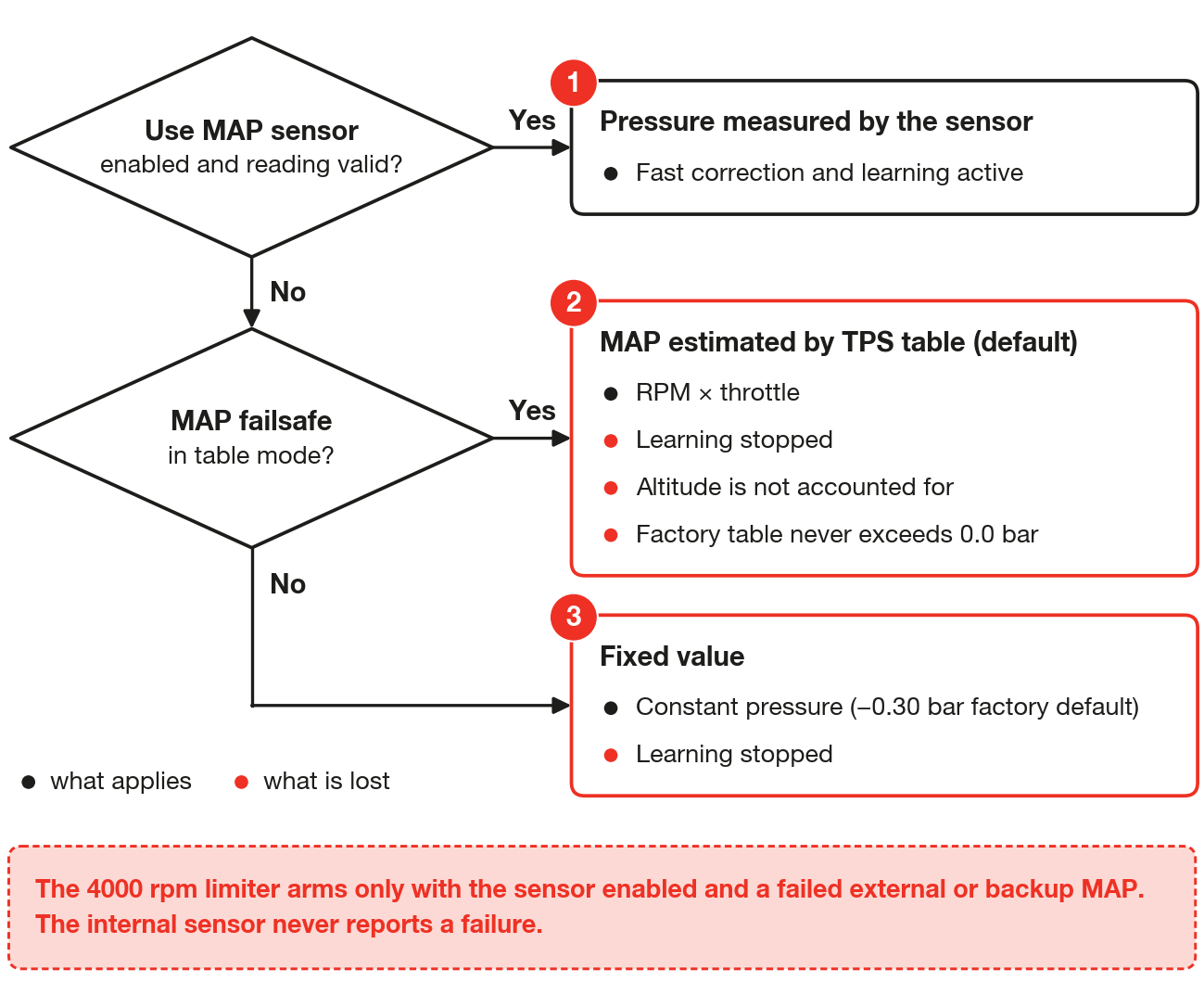
Without a tap that represents the runners, there is the option of turning off Use MAP sensor. With the MAP failsafe at the default, MAP estimated by TPS table, the VE starts using the MAP estimated by TPS table, and you lose three things:
- The learning stops. The fast correction from the O2 sensor continues, and the screen shows VE model sensor in failsafe.
- The 4000 rpm MAP failure limiter stops acting: it only arms with Use MAP sensor on and an external MAP sensor as primary (see Before you start: engine, fuel, injectors and sensors).
- The altitude does not enter the calculation. With a table made at sea level, the engine runs about 11% rich at 900 m at full load, more than the ±8% that the fast correction reaches by default at 0 bar.
If you use the estimated table, fill each cell with the average MAP measured in the log at that engine speed and throttle opening. The table enters the air calculation as pressure, not as just any load index.
Turbo with individual throttle bodies and no tap that represents the runners: do not use VE with the estimated table, which is fixed and does not follow the real turbo pressure.
#Air temperature: the sensor reading
The calculation uses the air temperature sensor reading. There is no blend with the engine temperature nor a charge heating model in the manifold. Install the sensor where it measures the air that goes to the cylinder and check it with test 6 of True VE.
A reading outside −30 to 120 °C goes to the failsafe (25 °C by default). A faulty sensor that reads 0 °C passes as valid: with the real air at 40 °C, the engine enriches about 15%.
If the learning Diagnostic flags Charge temperature (correlation with IAT), check the position and the reading of the air temperature sensor: the calculation does not mix the air temperature with the engine temperature.
#Without a MAP sensor: the estimated pressure
Without a MAP reading, the VE uses the MAP failsafe, and the factory MAP estimated by TPS table was made for a naturally aspirated engine: it does not go above 0.0 bar. On a turbo engine, do not run without a MAP reading or with Use MAP sensor off (see Before you start: engine, fuel, injectors and sensors).
#Other limits
- The closed loop uses an average O2 sensor, Closed Loop / VE Probe, and corrects all the banks and cylinders with the same factor.
- A single measured fuel pressure applies to the three banks.
- Power and torque in VE mode are estimates from the fuel flow rate and a typical specific consumption of the fuel. Use them as a trend.
- The Pro-Nitrous fuel and the PWM progressive nitrous fuel are not applied in VE mode, and the mixture goes lean when the nitrous is activated: see What does not run in VE mode, in Enrichments and compensations in VE mode.